


The Sun
The Sun is a Main Sequence star and therefore derives its energy from the fusion of Hydrogen nuclei into Helium. This process, known as the p-p cycle, starts with four Hydrogen nuclei and produces one Helium nucleus, and energetic positrons, neutrinos, and gamma rays.
Four Hydrogen nuclei have a combined mass of
M =
= 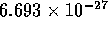 kg
and one Helium nucleus has a mass of M
kg
and one Helium nucleus has a mass of M =
= 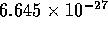 kg.
The difference in the initial and final total mass in each fusion process,
kg.
The difference in the initial and final total mass in each fusion process,
 M = M - M =
 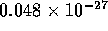 kg, is converted into energy (and the Sun ``loses" this mass). This is the
famous
kg, is converted into energy (and the Sun ``loses" this mass). This is the
famous  , where m in this
case is the difference in the masses M and c is the speed of light.
The amount of energy released every time
this takes place is M
, where m in this
case is the difference in the masses M and c is the speed of light.
The amount of energy released every time
this takes place is M c
c =
=  Joules.
Star bright: Powering the Sun
The Sun's total luminosity,  Watts (or Joules/second)
 , is ultimately derived from the energy released by many fusion
reactions each second.
, is ultimately derived from the energy released by many fusion
reactions each second.
1. How many fusion reactions per second are required to sustain the Sun's luminosity of Watts?
Your answer should be roughly
100,000,000,000,000,000,000,000,000,000,000,000,000 (10 )!!
)!!
2. The Sun is losing mass each time a fusion reaction occurs. What is the rate at which the Sun's mass is decreasing (in kilograms per second)?
Your answer should be about
several billion (10 ) kg / s. Since
one ton is 10
) kg / s. Since
one ton is 10 kg, express this in millions (10
 ) of tons per
second. If one car weighs about 2 tons, how many millions of cars per second is this?
) of tons per
second. If one car weighs about 2 tons, how many millions of cars per second is this?
3. How many years does it take for the Sun to lose the equivalent
of the Earth's mass, M =  kg? Express this number in
years (there are approximately
kg? Express this number in
years (there are approximately  seconds in a year).
That's a mighty long time: Lifetime of the Sun
1. Here are pretty good assumptions about the Sun:
 . The Sun was initially composed only of pure Hydrogen;
 . The Sun's luminosity does not change over time;
 . The Sun will use about 10% of its initial mass in fusion reactions;
 . The Sun's total mass is approximately
  kg, which hasn't changed much since the Sun formed.
Use this information to estimate how long the Sun can fuse Hydrogen into Helium.
2. We can't directly measure the age of the Sun. However, the oldest rocks
found on the surfaces of the Earth and
the Moon are about  years old. What does this tell us about
the current age of the Sun? How much longer will the Sun remain on the Main Sequence?
years old. What does this tell us about
the current age of the Sun? How much longer will the Sun remain on the Main Sequence?
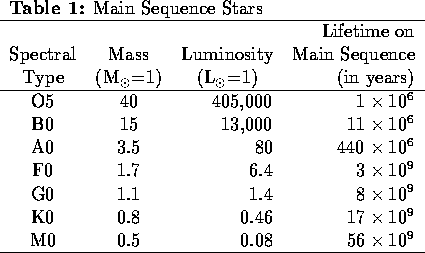
3. Look at Table 1. The Sun is a G2 star. You might expect that stars
more massive than the Sun will live
longer than the Sun because the massive stars have more fuel available to
burn: for example, a 15 M star should last 15 times longer
than the Sun, or
star should last 15 times longer
than the Sun, or  years. But according to this table
a 15 M star lasts a mere
years. But according to this table
a 15 M star lasts a mere  years. Why?
4. The age of the Universe is believed to be close to  years. Which classes of stars have never left the Main Sequence? Explain.