Return to Dr. Sohl's home page.Professional Interests:
Applied physics and engineering: Most of my current efforts are part of the HARBOR project. We are currently building near-spacecraft that we fly to the edge of space (100kft, 30km) under high altitude weather balloons. Current activities include:
- The MSA (Multi Sensor Array) is a system that monitors atmospheric and positional information. The sensor suite is dynamic and changes from flight to flight, but the standard sensors are tuning out to be: onboard and outboard temperature, humidity, atmospheric pressure, dust, GPS position, 3 axis accelerometer (both high and low range), 3 axis magnetometer, and 3 axis gyroscope.
- Aerosol (dust) monitoring. We have a very fancy clean room air monitor that we fly and we are now adding a small (less capable) dust monitor that will reside on the MSA for most regular flights. Two students are building a sample return system that will (hopefully) collect some dust particles from the stratosphere and return them to us so we can analyze them in the scanning electron microscope to see if we can determine the origin of the particulates.
- Instrumentation in space like environments. We are building a special vacuum chamber that will allow us to test flight instrumentation at the pressures of near space. (Which are the same as the pressures at various points on Mars' surface.)
- Telemetry. A future project (near future, I hope) is to include high speed data downlinks from the edge of space. We want to have two way communications with the craft so we can control all systems and get all data live. This will also give us data security since a lost spacecraft wouldn't bring its data down with it.
Atomic and laser physics:
- Highly excited energy levels in transition group elements. This involves using several high power pulsed lasers to probe an atomic beam. The atoms in this beam are then ionized and detected via a mass spectrometer. This allows us to do finely detailed studies of the internal structure of complex atoms.
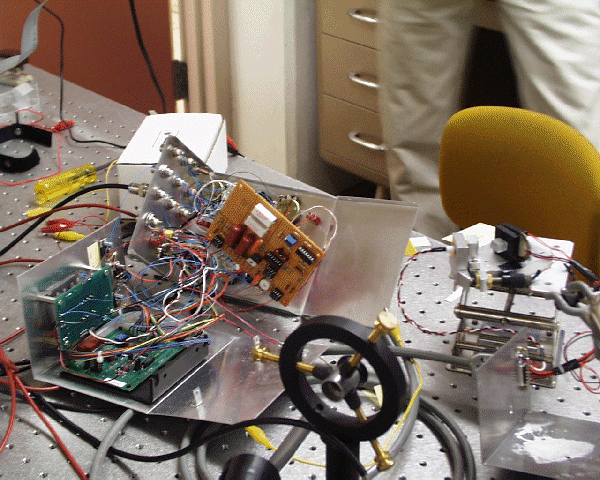
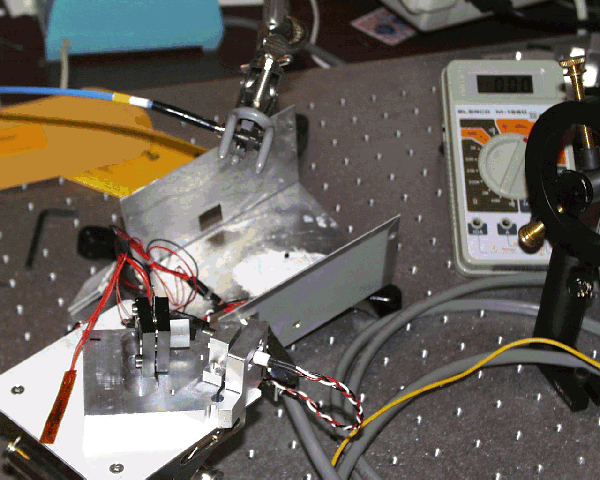
- Laser cooling and trapping. We are building a set of three high precision moderate power diode lasers to be used for trapping and cooling rubidium atoms. This is very similar to the work that was awarded the 1997 Nobel Prize in Physics. Click here for a picture of the laser diode assembly. Click here for a picture of the laser diode head.
Biophysics:
- Ultraviolet vision in animals. Currently I'm working with Dr. John Mull on a project to investigate UV vision in ants. For the ants we are controlling the light in their environment to see if it changes their seed collecting behavior. We have already imaged the seeds they prefer and those seeds have a strong UV signature. In the past I have also worked with anoles (lizards). It turns out that some lizards can see in the ultraviolet. We used a specialized UV sensitive CCD Camera to image the anoles to see what they can see. The appearance of the animal is completely different than in visible light.
- A recent student built a system to measure the dynamic motion of horse's hooves. It is a radio link to three axis accelerometers that allowed us to measure the impact forces and angles experienced by a race horse. (Barrel racing in this case, but that doesn't matter.) She got great preliminary data but then graduated. If another student wants to pick up this project, it is ready to go, although we would start by building a new and even better sensor system using what we learned from the first try.
- An old project was on the Biological effects of low level electromagnetic fields. Depending on time and student interest, this could be powered back up at any time. We built 50 special chambers to generate emf's. We can load as many as 5,000 samples in these chambers. In typical use, half of the chambers are "on" and half are "off." Once the data is collected and analyzed, we then compare the emf exposed samples with the control samples. In these double blind experiments we are initially set up to do microbiological colonies and seed germination. (Neither of these require light, hence they are easier to control for uniformity of environment.) Other samples could be considered. (On a related note, all evidence at the moment indicates that your cell phone's RF emissions are not going to kill you. Texting while driving will, but not the emf.) HERE IS AN UPDATE: A student, Sam, has taken on this project and the solenoids will run again soon!
Science Education:
Return to Dr. Sohl's home page.
- I am interested in both formal and informal science education. I have been actively involving technology in the classroom in many forms such as computer animations of three dimensional concepts (for example, the shape of our galaxy, how eclipses occur, etc.), computer simulations of how astrophysicists collect and use data, and using computers for student testing.
- Science Outreach. I am now the director of the WSU Ritchey Science and Engineering Fair of northern Utah. I have spent a lot of time working with students in science fairs from the elementary school level to being a judge at the Intel International Science and Engineering Fair (ISEF) for several years now. I was also a major player in the exhibits that were initially installed at the Clark Planetarium.
Please send comments to:
Dr. John Sohl
COMMENTS