Sinusoidal Wave Square Well Harmonic Oscillator Wavepackets Barrier Scattering

Two-state (spin-1/2) version Three-state (spin-1) version
Written by Daniel V. Schroeder except as noted.
These HTML5/JavaScript web apps should run in any modern web browser and on many mobile devices.
|
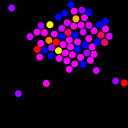
Interactive Molecular Dynamics simulates up to 2500 interacting particles in two dimensions, so you can explore phases of matter, emergent behavior, irreversibility, and thermal effects at the nanoscale. |
|
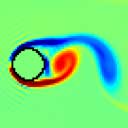
Fluid Dynamics simulates a two-dimensional fluid in a wind-tunnel arrangement using the lattice-Boltzmann algorithm, demonstrating vortex shedding and forces on barriers. |
|
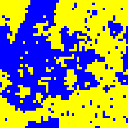
Ising Model simulates a magnet in two dimensions using the Metropolis algorithm, with the ability to rescale the lattice at any time. |
|
Electric Potentials and Fields (by WSU student Nathaniel Klemm) solves Laplace’s equation for the electrostatic potential around an arbitrary arrangment of user-drawn conductors. |
|
Wave Builder is a computer-aided exploration of building arbitrary wave shapes out of sine waves or other simple basis functions. |
|
Quantum wavefunction simulations showing time evolution in one dimension: Sinusoidal Wave Square Well Harmonic Oscillator Wavepackets Barrier Scattering |
|
Quantum Bound States in Two Dimensions displays two-dimensional wavefunctions for a variety of user-adjustable potentials. |
|
Entanglement in a Box displays the entangled low-energy wavefunctions for two interacting particles in a one-dimensional box. |
|
Quantum Scattering in Two Dimensions simulates scattering of a wavepacket from a variety of two-dimensional barriers. |
|
Colliding Wavepackets simulates a two-particle quantum collision, showing how independent particles become entangled when they interact. |
|
Quantum Matrix Diagonalization Visualized (by WSU student Kevin Randles) helps you find bound states in one dimension by rotating the basis states until the Hamiltonian matrix is diagonal. |
|
Spins Laboratory, a simulation of linked Stern-Gerlach devices: Two-state (spin-1/2) version Three-state (spin-1) version |
|
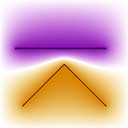
Two-Source Interference is a simple animation of wave propagation from a pair of identical sources with variable separation. |
|
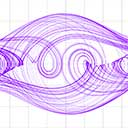
Chaotic Pendulum is a simple simulation of a damped, driven pendulum, with a phase space plot. |
|
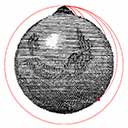
Newton’s Cannon animates Isaac Newton’s famous thought experiment of firing projectiles horizontally from a high mountaintop. |
|
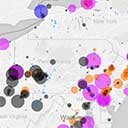
U.S. Power Plants is an interactive map that shows where our electricity comes from. |
|
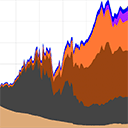
U.S. Historical Energy Use is an interactive chart of data from 1800 to the present. |
If you would like to learn to create your own HTML5/JavaScript simulations, here are the tutorial materials that I created for a workshop on the topic, first offered at the summer 2014 AAPT meeting. Prior to that I wrote a blog article summarizing my benchmark results with some of these simulations, and another blog article listing other HTML5 physics simulations as of October 2013.
Software for older platforms is now listed on a separate page.
I also recommend the amazing software collection at Falstad.com, and the cartooney but often useful PhET physics simulations.
Last modified on 14 July 2022.